
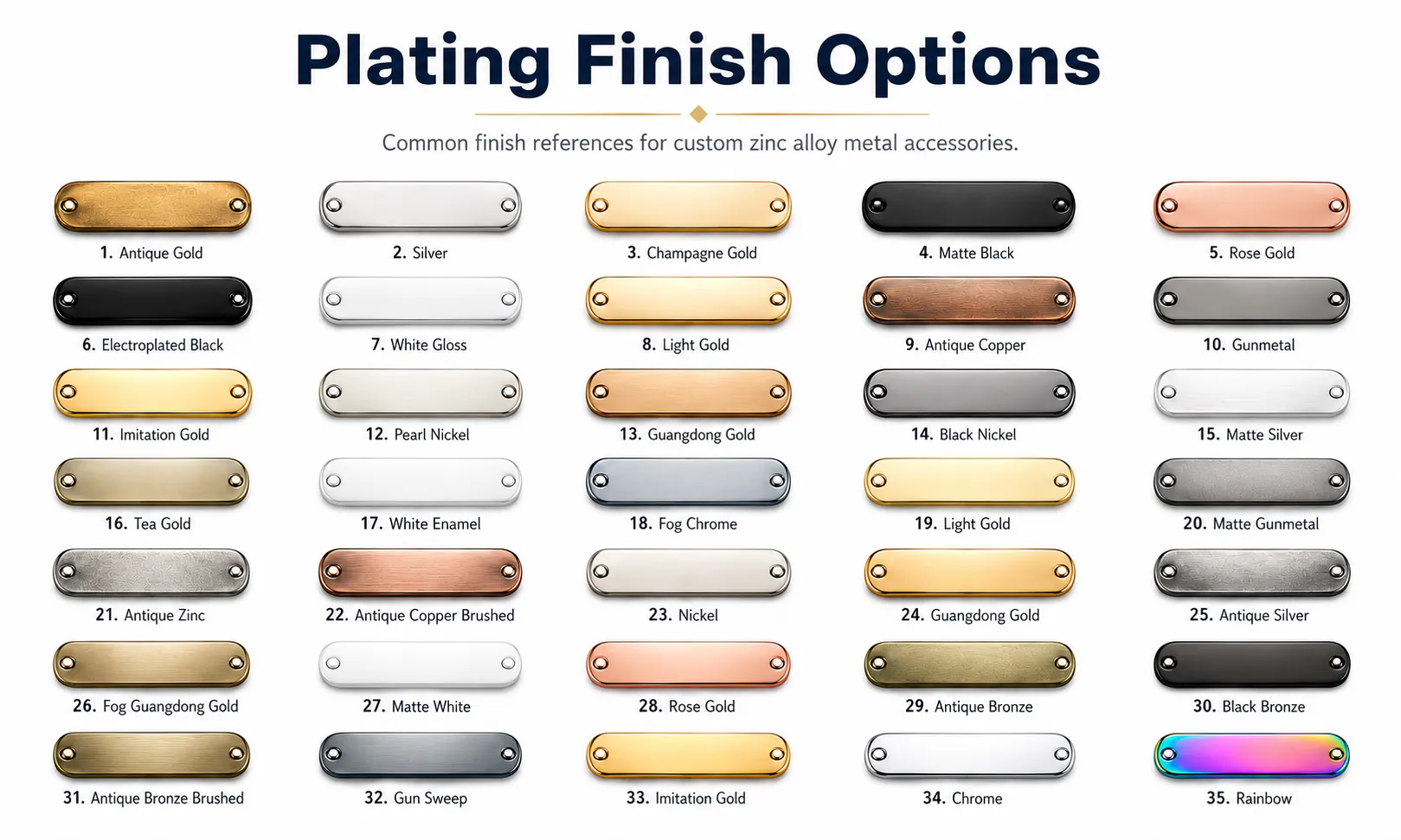
Saying 'antique brass' to five factories will get you five different samples. Finish names are convenient shorthand, but they do not specify tone, polish level, logo contrast, or texture. They are a starting point, not a specification.
A reference photo or physical sample does the work a color name cannot. It shows whether you want a bright tone, an aged effect, a brushed texture, a matte surface, or filled color detail — and at what intensity.
This article covers the practical finish directions for zinc alloy metal hardware, with notes on where each works well and where it does not.
Why finish references are more useful than finish names
One buyer's antique brass is warm and polished. Another expects a dark aged effect with strong recessed contrast. Both are describing the same finish name — and expecting completely different results.
A reference aligns the visual target before sampling begins. It also lets us confirm whether the direction suits the logo process, surface shape, filling requirement, and application.
Common finish directions for zinc alloy hardware
Standard directions: antique brass, antique silver, gunmetal, nickel color, brushed silver, light gold, rose gold, matte black, painted finishes, electrophoresis, and filled color effects.
The right choice depends on product structure. A flat logo plate, raised badge, zipper puller, snap button, and shoe trim each show the same finish differently — this is not a minor variable.
Antique brass, antique silver and gunmetal
Antique brass and antique silver suit vintage, leather goods, and decorative trim applications. These finishes pull recessed lines and raised logos into contrast, which is why they are common in bag hardware and premium accessories.
Gunmetal delivers a darker, more controlled metal look. Check the final tone against logo depth and product size — small text and polishing contrast are where the decisions get complicated.
Light gold, rose gold, nickel color and brushed silver
Light gold and rose gold work in fashion accessories, packaging details, and decorative metal trims. Match them to a reference rather than a name — the tone range within each is wide enough to matter.
Nickel color and brushed silver are the cleaner choices. Brushed effects depend on surface shape and part geometry, so confirm with the actual product before committing to the direction.
Matte black, painting, electrophoresis and filled color
Matte black creates a controlled, contemporary look. Spray painting and electrophoresis are available for specific structures — the right route is determined by the part, not by default.
Enamel, lacquer, or oil filling makes letters and recessed details readable. The recessed area needs sufficient depth and width to hold the fill cleanly; if it does not, the artwork needs to be adjusted before the mold is cut.
Why product structure changes the finish result
Finish does not behave uniformly across every surface. Raised logos, recessed lines, curved faces, thin edges, and deep textures all change how tone and contrast read after processing.
Application adds another variable. A garment accessory, bag plate, shoe trim, and packaging emblem carry different expectations for touch, wear, assembly conditions, and viewing distance.
What buyers should send as finish reference
A physical sample is the clearest reference. If you do not have one, send clear photos under natural light, an existing product image, or a finish chart direction. Do not rely on color names alone.
Include product type, logo process, size, application, and any testing requirement. Finish discussion resolves faster when the visual target and the actual part are reviewed together.
Practical questions buyers often ask
Which finish reference should I send?
A physical sample is best. Clear product photos under natural light or a finish chart also work — anything is more useful than a color name on its own.
Can I choose antique brass, gunmetal or matte black?
All three are available. Suitability depends on product structure, logo process, and application — we confirm fit once we see the part.
Can color filling be added?
Yes, where the recessed area and logo detail are suitable. If the geometry is too shallow or narrow, the artwork needs adjustment first.
Why does the same finish look different on different parts?
Surface shape, polishing area, logo depth, texture, and product size all affect how a finish reads. This is why we review finish together with the part, not separately.
Share a finish reference — a physical sample, product photo, or finish chart. We'll confirm whether it works with your logo process and part structure.
Discuss Your Finish